Book Now
Your Feet Carry
You Everywhere
Give them the care they deserve. Book a consultation today, or browse the products our podiatrists recommend.
Book Now
Give them the care they deserve. Book a consultation today, or browse the products our podiatrists recommend.
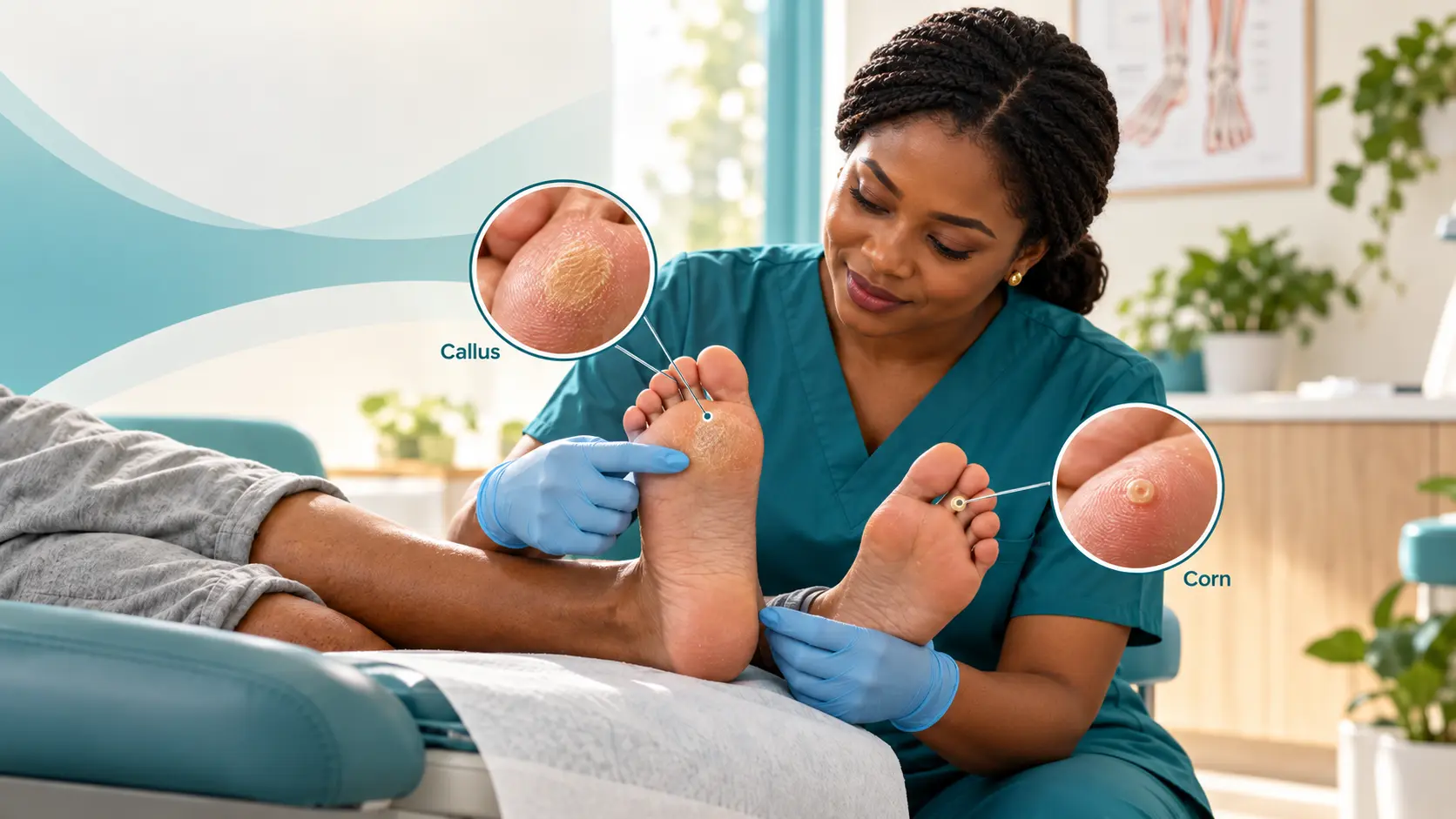
There is a hard patch on your foot. It has been there for months, it is starting to hurt when you walk and you are not sure whether to file it down, buy a medicated plaster or leave it alone.
Whether it is a callus or a corn changes the answer. People treat the two as the same thing, reach for the same pumice stone or the same corn plaster and wonder why the problem keeps coming back.
They are related, but they are not identical and at Podiatrist.ng by Flawless Esthetics Clinic they are treated differently. This guide shows you how to tell them apart, what causes each one and the point at which filing it yourself stops being a good idea.
Skip the home remedies and book an appointment if any of these apply;
A callus or corn on a foot with reduced sensation can break down into an ulcer without you feeling it, which is how a minor skin problem becomes a serious one.
A callus is a broad area of thickened, hardened skin that builds up gradually where the foot takes repeated friction and pressure.
They form on pressure points, the places your body weight lands as you walk, most often the heel and the ball of the foot. They are usually larger than corns, flatter and spread out with no clear border .
Most calluses do not hurt. That is why people leave them for years, until the skin becomes thick enough to crack.
A corn forms at a pressure point too, but the thickening is concentrated rather than spread out.
Corns are smaller and deeper than calluses, with a hard centre surrounded by inflamed skin, and they are painful when pressed . Hard corns usually appear on the tops or outer edges of the toes. Soft corns form between the toes, where trapped moisture keeps them soft.
There is also the seed corn, a small deeply embedded point of hardness that can be surprisingly sore for its size.
Use this while looking at your own foot.
| Callus | Corn | |
| Size | Larger, spread out | Smaller, concentrated |
| Shape | Flat, irregular edges | Round, with a defined centre |
| Where | Heel, ball of the foot | Tops and sides of toes, between toes |
| Pain | Often none | Tender, especially when pressed |
| Feel | Broad rough patch | Hard point, sometimes with a core |
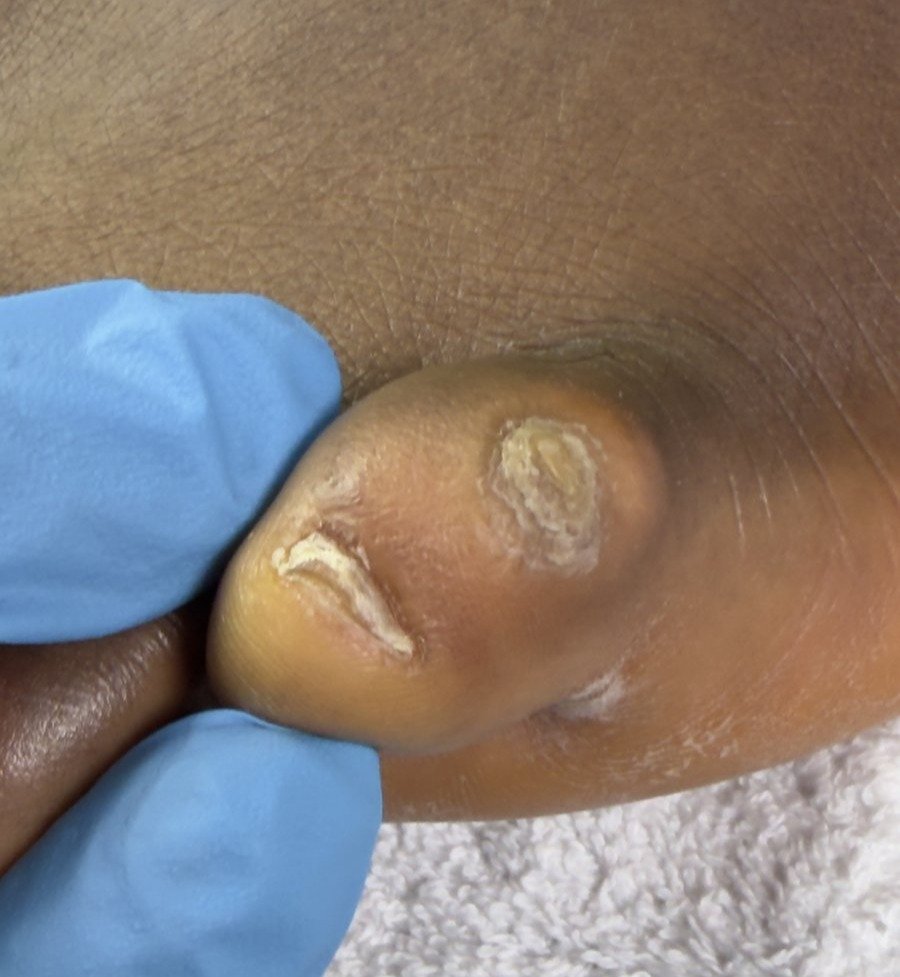
If you are still unsure, look at the border. A callus fades gradually into normal skin. A corn has an edge you can see and a centre you can press.
They share one cause: friction and pressure repeated over time, which makes the skin thicken to protect itself. Remove the source and both usually disappear on their own
In practice the source is usually one of these.
Notice that four of those five are about footwear. Treating the hard skin without changing the shoe is why it grows back.
Corns and calluses are among the most common things patients bring to the clinic and they are treated differently because they are not the same.
For calluses and for milder soft tissue corns, the clinic uses shaving and debridement techniques to carefully reduce the thickened skin and buildup. For corns that keep recurring and are deeply embedded, a surgical procedure is used. The skin is numbed, the corn is cut out, then the area is stitched up afterwards with regular wound dressing done until it is completely healed.
For corns sitting on bony tissue, debridement can also be done but a more permanent solution is to surgically take it out through minimally invasive procedures.
Calluses and corns are not the same thing and they are not addressed the same way. A callus is thickened skin spread over a pressure point. A corn is centralised, smaller and often deeply embedded. Treating one as if it were the other is why patients keep having the same problem again and again.
Christiana Dogo, Director, Flawless Esthetics Clinic
Wear shoes that fit properly, with room across the toes and wear socks with your closed shoes. Soak the foot in warm water to soften the skin, then use a pumice stone gently on the callused area. Keep the skin moisturised so it stays supple rather than cracking. Use a protective pad over a corn to take the pressure off it while the shoe problem gets sorted.
Two things to avoid. Do not cut or shave hard skin off yourself with a blade or razor, because you cannot judge the depth and an open wound on the sole is easy to get infected. Be careful with medicated corn plasters, which contain acid that removes healthy skin along with the corn, especially risky for anyone living with diabetes.
Treating the skin and ignoring the shoe. The hard skin is a symptom. If the friction stays, it returns.
Assuming a painful lump is a corn. Warts can look similar and they are treated differently, which is one reason a professional look is worth it when you are unsure.
Filing it down aggressively. Removing too much skin, leaves the skin underneath raw and unprotected.
Leaving it for years because it does not hurt. Calluses thicken, then crack and cracks on the heel is how infection sets in.
Broad, flat and painless is usually a callus. Small, deep and tender is usually a corn. Both come from pressure and friction and will reoccur if the source of the pressure and friction is not addressed.
If it is painful, keeps recurring or you are diabetic, stop guessing and have it assessed properly. Book a consultation with podiatrist.ng, available virtually or in-clinic. The consultation fee ranges between N25,500 to N50,500 and the treatment fee is advised after the consultation is done. You can also read more about corn removal and callus treatment.
Can a callus turn into a corn?
We have established that they are not the same foot concern, so one does not become the other. But the same badly fitting shoe can produce a callus in one spot and a corn in another.
Why does my corn keep recurring after I remove it?
Because the pressure and friction that caused it is still there. Until the footwear or the underlying foot shape is addressed, the skin will keep thickening in the same place.
Are corn plasters safe to use?
They work for some people, but they contain acid that does not distinguish between the corn and the healthy skin around it. Anyone who is diabetic, suffering from poor blood circulation and neuropathy should avoid them entirely.
Is it a corn or a wart?
They look alike. A rough guide is that warts often hurt when squeezed from the sides while corns hurt when pressed straight down, but the reliable answer comes from having it examined.